


What happens after your last trial appointment
As a participant in the NHS-Galleri trial, you were invited to three appointments over two years, about 12 months apart. At each appointment, you were asked to give a blood sample and fill in a short health survey.
Your third (24 month) appointment was your last appointment for the NHS-Galleri trial. Even though you will not be asked to attend any more appointments, you will still be an important part of the trial. This is because information about your health will still be shared by the NHS to help with the trial.
Also, your blood samples might be used for other research in the future. You cannot be identified from this information.
Attending your usual cancer screening appointments
It is very important that you keep attending your usual cancer screening appointments when you are invited to do so. You should also make an appointment to talk to your GP if you notice any symptoms that are new or unusual for you.
The researchers have published the first results from the NHS-Galleri trial. They will continue to analyse the data from the trial over the coming months and years. More results will be reported in the future.
What happens next with your information
At your first appointment, you filled in a consent form to confirm that you wanted to take part in the trial. In this form, you agreed to allow the NHS to share information about your health that is relevant to the trial, such as your use of health services, whether you have had a cancer diagnosis, and the types of tests and treatments you might have received. This data is from records held in national databases. You also agreed to fill in surveys about your health at each appointment.
Information about your health will be collected from the NHS for up to 10 years from when you joined the trial.
The health data is pseudonymised, which means that any information that could identify you, such as your name, date of birth, and NHS number, is removed and replaced with a code number. Your identity will always be confidential in any trial results that are published.
Using information about your health shared by the NHS alongside the health information you have given at trial appointments will give the researchers the best chance to understand how the NHS might be able to offer the test to people in the future.
Information the trial has collected about you will be kept for up to 20 years after the trial finishes.
You can ask for the collection of information about your health from the NHS to stop at any time. There are no consequences, and you do not have to give a reason why. However, information about you that has already been collected will be kept.
If you would like to stop this data collection, please contact the trial team.
What happens next with your blood samples
At each trial appointment, you gave a blood sample. What happens next with your blood samples depends on if you are in the test group or control group of the trial:
- If you are in the test group, your samples were sent to GRAIL, Inc. in the United States (US), for testing with the Galleri® test.
- If you are in the control group, your samples have been stored in the UK and were not tested immediately. Your samples might be sent to the US to be tested in the future.
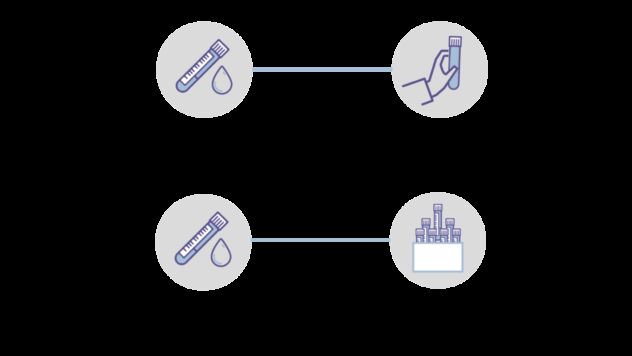 Samples from the test group were tested with the Galleri test. Samples from the control group have been stored for future research.
You will not be told if you are in the test or the control group, not even after the trial has finished. If people know which group they are in, it might alter the way they behave about their health. This could make the research results less clear or reliable.
Your blood sample details were pseudonymised. This means that any information that could identify you, such as your name or date of birth, were removed and replaced with a code number.
At your first trial appointment, you were asked if your blood samples could be stored and tested at a later date to help with future research.
Future research might include work to further improve the Galleri test, and to develop and improve other tests and see how well they work.
Research using your samples will not involve two specific types of genetic analysis. These are called whole genome sequencing and exome sequencing. These genetic analyses can say a lot about your risk of developing particular health problems, or about your ancestry or ethnicity. Even if you gave permission for your samples to be used in future research, these particular types of genetic analysis will not be done on them.
Allowing your samples to be used for future research could help detect cancer in people in the future.
You will not receive any updates about your samples being used in future research, not even after the trial is finished. You will not benefit financially if a product or test is successful because you have been involved in the trial.
Your samples will not be used for any other purpose and will not be shared with any other organisation. You cannot be identified from any of the information used in future research.
Samples from the control group might be sent to the US if they are used for future research.
You can change your mind about your blood samples being stored for future research. There are no consequences, and you do not have to give a reason why. If you do not want your samples to be stored for future research, please contact the trial team. Your stored samples will then be destroyed.
What happens next with the trial
The first results from the NHS-Galleri trial are now available.
More results will be available in the coming months and years, as researchers carry on collecting and analysing data from the trial. Some of the other things they are looking at are if people who have a cancer signal detected result feel anxious, if the test is good value for money and if using the test might help reduce cancer deaths.
The NHS and other health organisations will review the results of the trial in detail to understand how this type of test could be used in the future.
Thank you for taking part in the trial. The trial and everything that is being learned from it would not be possible without your support.
At the moment there are no future studies using the Galleri test planned in England.
The NHS and other health organisations will review the results of the trial in detail to understand how this type of test could be used in the future.